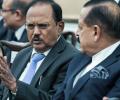
National Security Advisor Ajit Doval is likely to travel to Beijing within the next few weeks to lead the Indian delegation at a new edition of the Special Representatives dialogue on the larger boundary question that will be held after a gap of nearly five years, authoritative sources said.
The Ministry of External Affairs (MEA) on Friday said Modi will lead the Indian delegation at the summit. "The prime minister will lead the Indian delegation to the 20th summit of the SCO council of heads of state which will be held in the virtual format on Nov 10. The meeting will be chaired by Russian President Vladimir Putin," MEA Spokesperson Anurag Srivastava said.
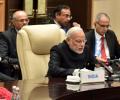
Modi in his address to the BRICS Leaders Meeting in Hangzhou said "terrorists in South Asia or any where for that matter do not own banks or weapons factories". "Clearly someone funds and arms them and BRICS must intensify joint efforts not just to fight terror but to coordinate actions to isolate those who are supporters and sponsors of terror," he said, without naming Pakistan which is a close ally of China.
A feature of this year's BRICS summit was economic cooperation.

India has called for a ceasefire, release of all hostages, and peaceful resolution of the Israel-Hamas conflict through dialogue and diplomacy. The Centre informed Parliament that India welcomed the agreement on the first phase of the Gaza Peace Plan. The article also covers India's energy sourcing strategy and the release of Indian fishermen by Pakistan.

India is keen on the issue of equal share holding since it doesn't want a repeat of the distortions that have crept into Bretton Woods institutions like International Monetary Fund, World Bank and the Asian Development Bank in which rich countries like the US and Japan have a strangle hold.
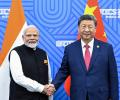
Prime Minister Narendra Modi has emphasized dialogue over discord in India's relationship with China, acknowledging natural differences between the two countries but stressing that stronger cooperation is essential for their mutual interests and global stability. In a podcast with Lex Fridman, Modi highlighted the ongoing efforts to restore normalcy along the border following the 2020 clashes, emphasizing the importance of a stable and cooperative relationship.
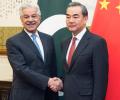
'No one knows Pak and understands Pak better than China,' Chinese Foreign Minister Wang Yi said.

The business council aims to give impetus to trade.

With its political colour dominated by less than democratic trends, BRICS currently leaves some of us wondering -- where in this grouping is there an assurance that human freedom will be respected unconditionally? It would be nice to see the new members of BRICS drawn from the ranks of countries wedded to preserving and guarding human freedom, observes Shyam G Menon.
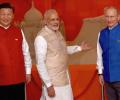
The Goa declaration didn't refer to Pakistan-based terrorist groups or cross-border terrorism.

He said the Fourth Industrial Revolution will have more importance than the capital.

Prime Minister Narendra Modi's bilateral meetings on the sidelines of the BRICS summit in Johannesburg are being finalised, Foreign Secretary Vinay Kwatra said on Monday but did not give a direct reply on the possibility of a meeting between Modi and Chinese President Xi Jinping.

Other world leaders too voiced concern against terrorism and vowed to fight it collectively.
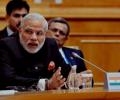
With Chinese President Xi Jinping listening, Modi said: "We must unitedly fight against it (terrorism), without any discrimination between groups, or countries, sponsors or targeted countries.
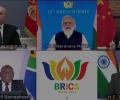
Asserting that it is for the first time that BRICS has taken a collective position on strengthening and reforming multilateral systems, Prime Minister Narendra Modi said, "We have to ensure that BRICS is more productive in the next 15 years".

'Many countries believe that if they join BRICS, they will be seen as emerging countries and their stature will be enhanced.' 'G-20 still has common action plans while BRICS does not do that much.'
India has lodged a "solemn protest" with China over the establishment of two new counties in the Hotan prefecture, as parts of these regions fall within India's union territory of Ladakh. The Indian government asserted that the creation of these counties will not impact its sovereignty over the area and does not lend legitimacy to China's "illegal and forcible" occupation.
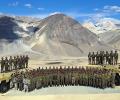
China has said that the disengagement of troops in eastern Ladakh by the Chinese and Indian armies is going on "smoothly" following a recent agreement between the two nations.

'...it should not delude itself into thinking that India's security or its great-power ambitions will be advanced by those partnerships.'
'Instead, what India should focus on is on riding out the next three-and-a-half years of Trump's presidency with minimal damage to itself.'

India will have the presidency of the BRICS' $100 billion New Development Bank for six years with headquarters in China that will become operational in about two years, a major step for reshaping the international financial system dominated by the West.

China's military has said it is willing to work with India to find a solution to the border issue, while also pushing for sound and stable defence ties. The statement comes after recent meetings between officials from both countries to normalize relations following a prolonged period of tension.

BRICS has no plans to form a military and political alliance, Russian President Vladimir Putin said on Wednesday, in an apparent effort to allay apprehensions of the West.

China has made serious inroads into Latin America, which the US may now be hinting is simply not ok: Stay in your lane, Xi! In simple terms, China will no longer have access to Venezuelan oil, points out Rajeev Srinivasan.
National Security Advisor Ajit Doval arrived in Beijing on Tuesday to take part in the India-China Special Representatives' talks to be held on Wednesday aimed at restoring the bilateral ties stalled for over four years' due to the military standoff in eastern Ladakh.

The sources have said that patrolling will begin at these points once the disengagement that began last week is completed and both sides will move their respective troops and dismantle temporary structures.
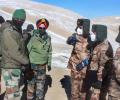
'The two sides should support rather than undermine each other, strengthen cooperation rather than guard against each other, and enhance mutual trust rather than be suspicious of each other'

Emerging nations have discussed delinking the quotas from the governance reforms to facilitate its passage.

The Global Times, a prominent state-run Chinese media outlet, published an article titled "China and India are cooperation partners, not rivals: Xi," highlighting President Xi Jinping's remarks about the bilateral meeting, saying, "as long as the two countries stick to this overarching direction, China-India relations can sustain steady and long-term growth."

Lavrov, who addressed the UN General Assembly shortly before External Affairs Minister S Jaishankar's speech at the high-level General Debate, said India and Russia share a "particularly privileged strategic partnership".

Cameron also said Modi has a very clear plan about technology and the future of India and his third consecutive term in office demonstrates the ability to bring real change in a consistent way.
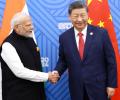
Chinese President Xi Jinping on Wednesday pledged to strengthen the strategic relationships with neighbouring countries by 'appropriately' managing differences and enhancing supply chain ties as China's tariff war with the United States escalated.

Prime Minister Narendra Modi visited Ethiopia on a bilateral visit, engaging with Ethiopian leadership to strengthen partnerships in various sectors. He was warmly welcomed by Prime Minister Abiy Ahmed Ali and participated in cultural events, highlighting the strong ties between the two nations.

It asked all nations to work together to expedite the adoption of the Comprehensive Convention on International Terrorism in the UN General Assembly without any further delay.
The collective West has always opposed strong leaders and economic development in India, asserts Colonel Anil A Athale (retd).

India and China have held their first diplomatic talks since withdrawing troops from two face-off points in eastern Ladakh, reflecting on the lessons learned from the border row to prevent future incidents. The two sides agreed to maintain peace and tranquillity in border areas, prepare for the next meeting of Special Representatives on the boundary question, and highlighted the importance of regular exchanges and contacts at diplomatic and military levels. The talks come after the completion of the disengagement process from the last two friction points, following an agreement finalized in October 2022.

India and China have made "some progress" in disengagement, External Affairs Minister S Jaishankar said on Sunday, describing it as a "welcome" move which opens up the possibility that other steps could happen.
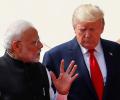
Delhi's appeasement strategy may now translate as more mega arms deals with the US, generating substantial business and job creation in the American economy. Make no mistake, Americans will use it to pressure India, predicts Ambassador M K Bhadrakumar.

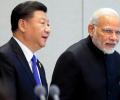
In their first structured bilateral talks in nearly five years, Prime Minister Narendra Modi and Chinese President Xi Jinping Wednesday agreed that India and China can have a 'peaceful and stable' relationship by displaying maturity and mutual respect and endorsed the pact on the resolution of the dragging eastern Ladakh border row.

The BRICS nations on Friday underlined the need for using local currencies in international trade and financial transactions besides committing themselves to supporting rule-based open and transparent global trade. A joint statement issued at the end of the meeting of the BRICS Ministers of Foreign Affairs and International Relations, also pressed for a robust Global Financial Safety Net with a quota-based and adequately resourced International Monetary Fund (IMF) at its centre. It further said the process of IMF governance reform under the 16th General Review of Quotas, including a new quota formula as a guide, should be completed by December 15, 2023.
